If you know me, you know I love creating things.
My creative career has spanned a few generations of technology—from building clip-art ads on a Macintosh Performa 600CD, to producing Wall Street sales books, to web development, graphic design, social media, and now…
AI.
For some people, artificial intelligence brings visions of machines taking over the world and humanity becoming unnecessary.
I see something very different.
For a creative person, AI feels a little like a dream come true.
I can take an idea that exists only in my head and begin giving it shape. An image. A video. A piece of music. A campaign. A website. A story.
But there is an important distinction.
AI isn’t doing the creative thinking for me. That’s my job.
The tools can generate possibilities, but I still have to decide what I am trying to say, who I am speaking to, what it should feel like, what belongs, what doesn’t, and when the work is actually finished.
When I started thinking about what to call this new chapter of my creative and technology career, one image kept coming back to me:
A loom.
The Loom
I’ve always known what a loom was, but the 2008 movie Wanted, starring James McAvoy, Angelina Jolie, and Morgan Freeman, made me see it differently.
In the movie, an ancient organization of assassins called the Fraternity operates from an old textile mill. At the center of its mythology is something called the Loom of Fate.
As fabric is woven, irregularities appear in the threads. The Fraternity interprets those imperfections as a coded message identifying people they believe will bring evil and chaos into the world.
The movie obviously takes the idea of weaving into fantasy territory.
But the image stayed with me. Threads moving through a machine. Individual strands becoming something larger. Information hidden inside a pattern.
And especially the shuttle moving back and forth across the loom.
The Shuttle
A loom begins with threads running lengthwise called the warp.
Then another thread—the weft—has to cross through them.
Traditionally, that thread is carried by a shuttle moving from one side of the loom to the other.
Back and forth.
Back and forth.
With each pass, separate strands become connected. Eventually, what began as individual threads becomes fabric. That is where the metaphor became personal.
I realized:
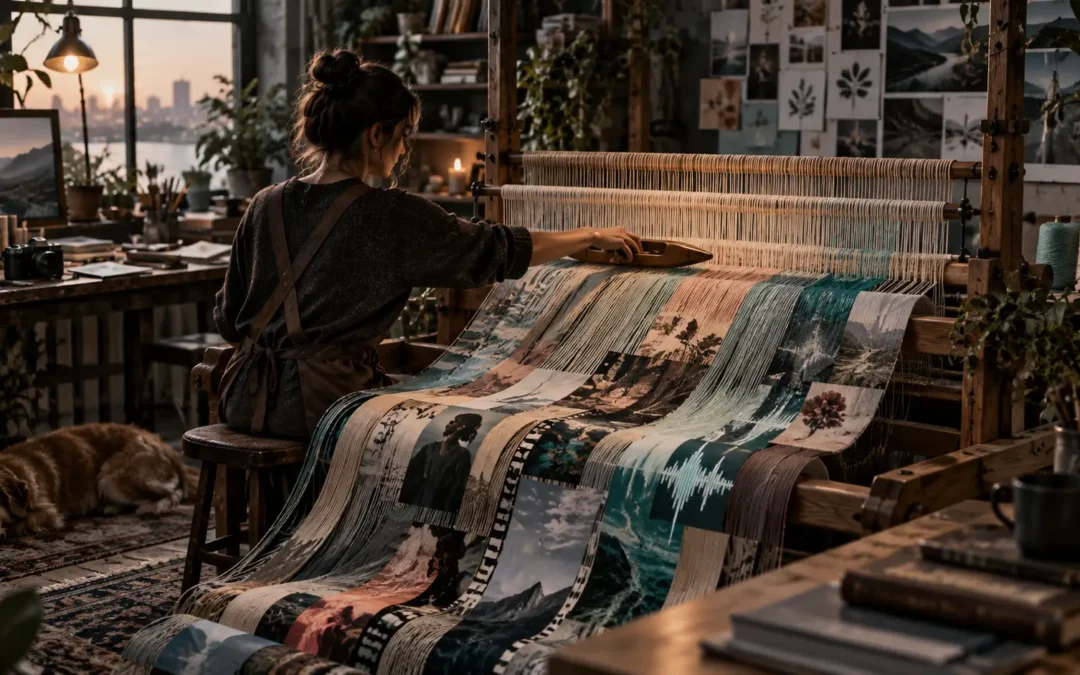
I’m the shuttle.
AI gives me access to an extraordinary collection of creative threads.
Photography. Illustration. Typography. Writing. Video. Music. Research. Strategy. Technology. Ideas.
But having all those threads doesn’t automatically create anything meaningful.
Someone still has to weave them together. Someone has to decide which thread belongs where. Someone has to recognize the pattern before the finished fabric exists.
That’s the role I see myself playing.
AI isn’t the loom weaving by itself.
And I’m certainly not standing on the sidelines typing a prompt and accepting whatever comes back.
I’m moving between strategy, imagination, technology, design, storytelling, and human experience—taking individual pieces and weaving them into something cohesive.
The tools have changed. The creative responsibility hasn’t. That is why Loom is part of the name.
AI Creative Loom.
Because the future of creativity, at least for me, isn’t about handing creativity over to artificial intelligence.
It’s about learning how to weave with new threads.